Volver al listado
Volver al listado
Azurita
Yacimientos Principales
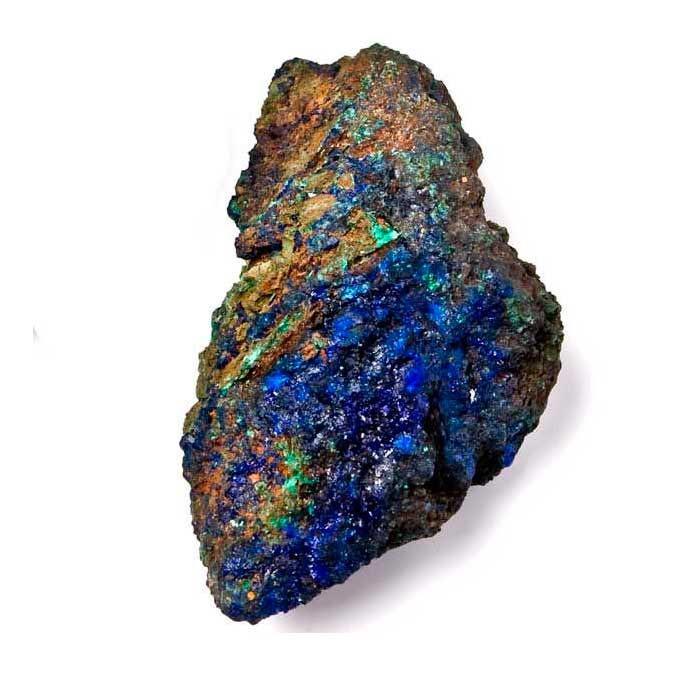
Azuritas las encontramos por muchos lugares, sobretodo en depósitos de cobre oxidados al aire libre. Los ejemplares más bellos proceden de Marruecos, Pakistán, Namibia o USA.
Descripción y Características
La azurita es un carbonato de cobre básico que se forma típicamente en las zonas de oxidación de los depósitos de cobre, resultado de la alteración de sulfuros primarios por aguas ricas en carbonatos. Pertenece al sistema de cristalización monoclínico y es famosa por su profundo color azul "azur" o cobalto. Es un mineral inestable en condiciones superficiales a largo plazo, por lo que frecuentemente se transforma en malaquita (verde) mediante un proceso de hidratación, manteniendo a veces la forma del cristal original (pseudomorfismo).
| Fórmula Química | $$Cu₃(CO₃)₂(OH)₂$$ |
|---|---|
| Lustre | Vítreo |
| Raya | Azul claro |
| Fractura | Concoidea a irregular |
| Exfoliación | Perfecta |
| Dureza | 3,5-4 Mohs |
| Sistema | Monoclínico |
¿Sabías que...?
Durante el Renacimiento, la azurita molida fue el pigmento azul más importante utilizado por los pintores europeos. Sin embargo, con el paso de los siglos, muchas zonas azules de frescos antiguos se han vuelto verdes debido a la conversión natural de la azurita en malaquita.
Propiedades New-Age
La azurita guía el desarrollo psíquico e intuitivo. Impulsa al alma hacía la iluminación. Limpia y estimula el tercer ojo y te sintoniza con la guía espiritual y te permite que los viajes fuera del cuerpo ocurran de manera sencilla y segura. La azurita es una poderosa piedra curativa que facilita la comprensión psicosomática del efecto de la mente y las emociones sobre el cuerpo. Mentalmente te ayuda a aportar una comprensión clara, con nuevas expectativas y expandir la mente. Emocionalmente, la azurita limpia el estrés, la pena, la preocupación y la tristeza, transmutando los miedos y las fobias. Ideal si la sostienes en tu mano derecha y sobre el tercer ojo, de no ser posible, llévala en contacto sobre el cuerpo.