Volver al listado
Volver al listado
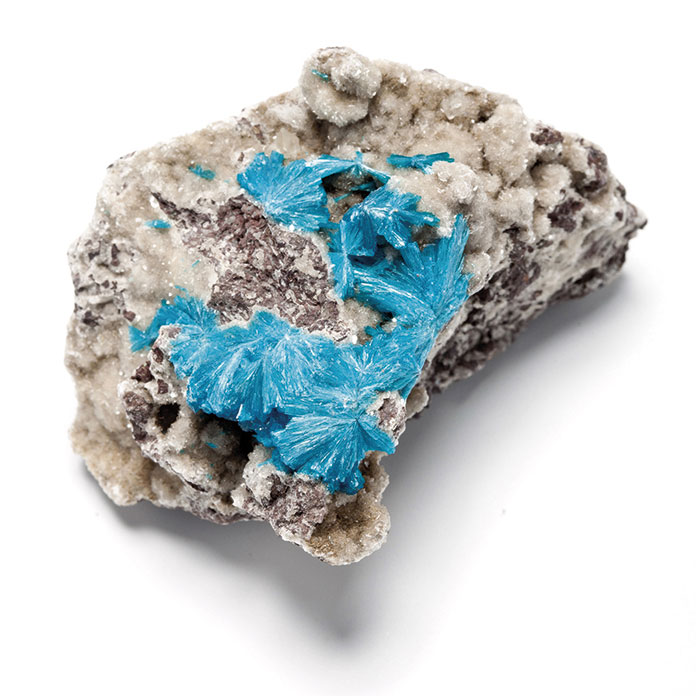
Cavansita
Yacimientos Principales
India (región de Pune) es la fuente principal y produce los mejores ejemplares del mundo. También se ha encontrado en Estados Unidos (Oregón) y Nueva Zelanda.
Descripción y Características
La cavansita es un silicato hidratado de calcio y vanadio (de donde deriva su nombre: Calcio-Vanadio-Silicato). Se localiza principalmente en las cavidades de rocas basálticas, formándose como un mineral secundario producto de la actividad hidrotermal. Pertenece al sistema de cristalización ortorrómbico y es famosa por presentarse en forma de pequeños agregados esféricos o "rosetas" de cristales aciculares que reposan sobre una matriz de estilbita blanca o apofilita, creando un contraste visual impresionante.
| Fórmula Química | $$Ca(VO)Si_4O_{10}·_4H_2O$$ |
|---|---|
| Lustre | Viítreo |
| Raya | Azul clara |
| Fractura | Concoidea |
| Exfoliación | Buena |
| Dureza | 3-4 Mohs |
| Sistema | Agregado |
¿Sabías que...?
El nombre de este mineral viene dado por los elementos que lo componen: Calcio, Vanadio y Silicatos.
Es un mineral "joven" en términos de descubrimiento, ya que fue descrito por primera vez en 1967. Debido a su fragilidad y belleza, los ejemplares en matriz (sobre piedra blanca) son piezas de colección muy valoradas y no deben limpiarse con agua caliente ni productos químicos, ya que pueden dañarse fácilmente.
Es un mineral "joven" en términos de descubrimiento, ya que fue descrito por primera vez en 1967. Debido a su fragilidad y belleza, los ejemplares en matriz (sobre piedra blanca) son piezas de colección muy valoradas y no deben limpiarse con agua caliente ni productos químicos, ya que pueden dañarse fácilmente.
Propiedades New-Age
La cavansita es conocida como la piedra de la revelación espiritual. Posee una vibración muy alta que ayuda a conectar con las dimensiones superiores y a procesar información metafísica.