Volver al listado
Volver al listado
Cianita
Yacimientos Principales
Brasil, India, Suiza, Estados Unidos, Rusia y Nepal.
Descripción y Características
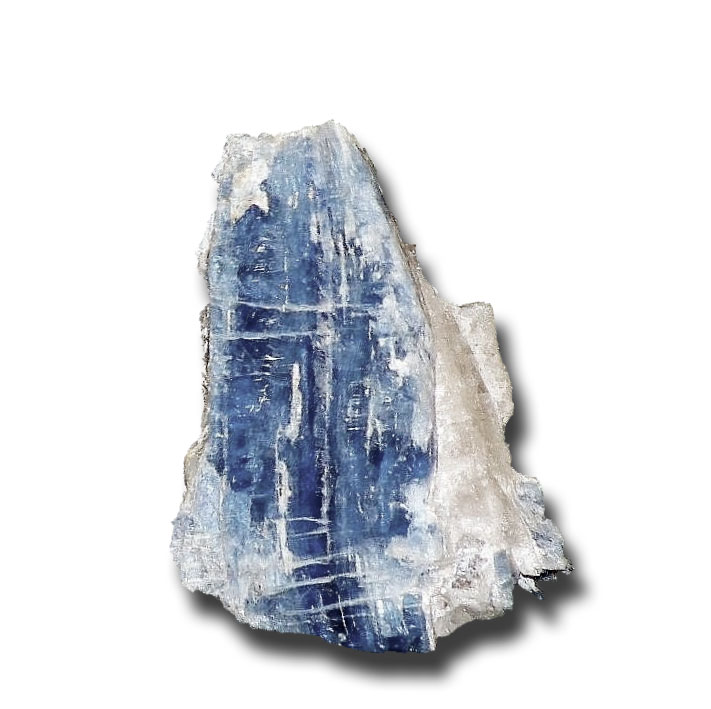
La cianita es un silicato de aluminio que se forma en rocas metamórficas (como esquistos y gneises) bajo condiciones de alta presión. Pertenece al sistema de cristalización triclínico y se presenta habitualmente en forma de cristales prismáticos, alargados y aplanados que recuerdan a láminas o espadas. Su característica física más inusual es la anisotropía extrema: tiene dos durezas diferentes en el mismo cristal según la dirección en que se raye, lo que le valió el nombre de "Distena" (dos fuerzas).
| Fórmula Química | $$A_{l2}SiO_5$$ |
|---|---|
| Lustre | Vitreo, nacarado |
| Raya | Blanca |
| Fractura | Astastillosa / Irregular |
| Exfoliación | Perfecta |
| Dureza | 4 a 4,5 Mohs |
| Sistema | Triclínico |
¿Sabías que...?
Su nombre "Cianita" deriva de la palabra griega kyanos, que significa azul. Es muy utilizada en la industria para fabricar porcelanas resistentes al calor y bujías, debido a que se expande de forma predecible a altas temperaturas.
Propiedades New-Age
La cianita es uno de los pocos minerales que no acumula ni retiene energía negativa, por lo que nunca necesita limpieza. Es una piedra de conexión que alinea instantáneamente los chakras y los cuerpos sutiles.