Volver al listado
Volver al listado
Mica Biotita
Yacimientos Principales
Madagascar (principalmente zonas de pegmatitas en las regiones de Antananarivo y Toliara)
Descripción y Características
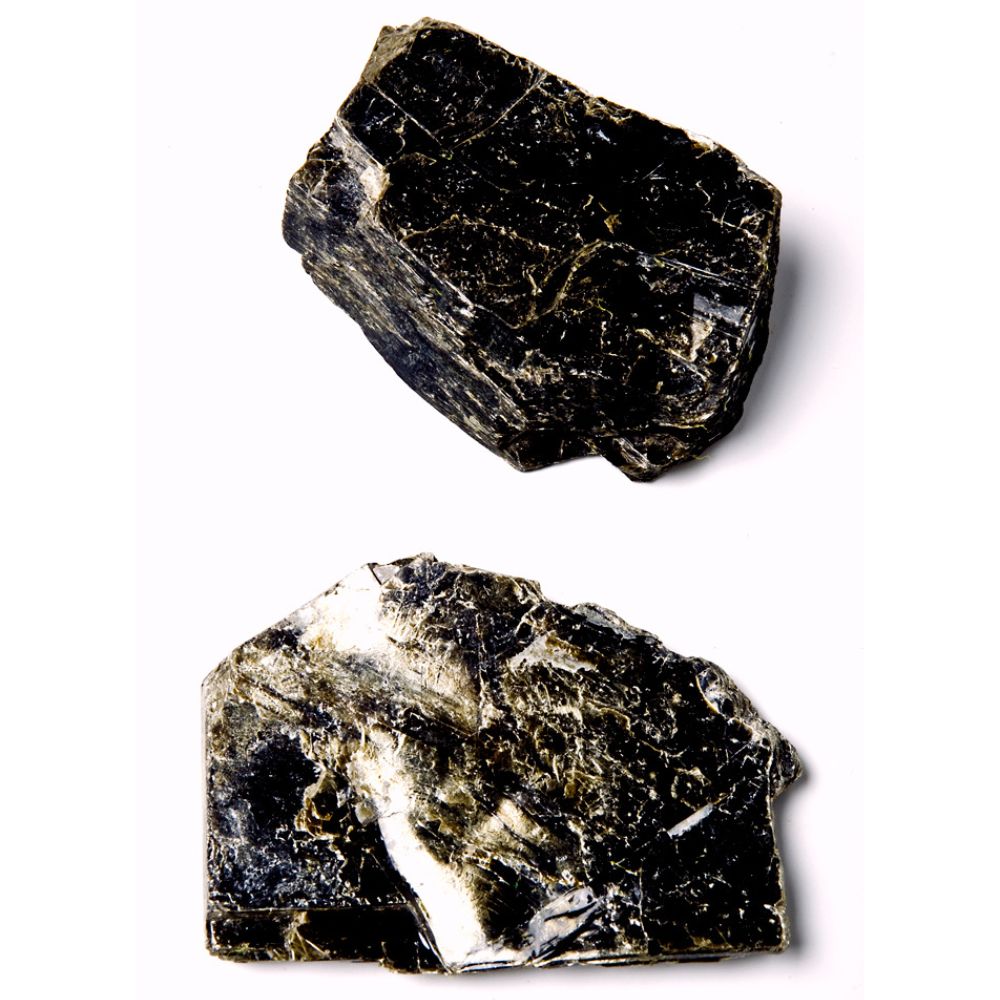
La biotita es un mineral del grupo de los silicatos (micas) que se caracteriza por su estructura laminar perfecta, permitiendo que se exfolie en láminas flexibles y muy delgadas. Los ejemplares de Madagascar son especialmente valorados por su gran tamaño y la perfección de sus cristales laminares negros o marrón oscuro.
| Fórmula Química | $K(Mg,Fe)_3AlSi_3O_10_(OH, F)_2$ |
|---|---|
| Lustre | Vítreo a submetálico; perlado en las superficies de exfoliación. |
| Raya | Blanca o gris clara |
| Fractura | No presenta (debido a su exfoliación perfecta), aunque los bordes de las láminas pueden mostrar una rotura irregular o astillosa |
| Exfoliación | Basal perfecta (micácea). Se separa con extrema facilidad en hojas o láminas muy finas, flexibles y elásticas |
| Dureza | 2,5-3 Mohs |
| Sistema | Monoclínico (frecuentemente en hábitos tabulares o laminares) |
¿Sabías que...?
Su nombre es un homenaje al físico francés Jean-Baptiste Biot, quien descubrió las propiedades ópticas únicas de las micas en 1816.
Antiguamente se la conocía como "vidrio de Moscovia" o "vidrio de hierro" debido a su resistencia al calor y su capacidad de ser cortada en láminas; gracias a esto, se utilizaba en las mirillas de los hornos industriales antes del desarrollo de los cristales modernos.
A diferencia de la moscovita (que es clara), la biotita contiene grandes cantidades de hierro y magnesio, lo que le otorga su característico color oscuro y la capacidad de alterar la lectura de brújulas si el ejemplar es muy masivo.
Antiguamente se la conocía como "vidrio de Moscovia" o "vidrio de hierro" debido a su resistencia al calor y su capacidad de ser cortada en láminas; gracias a esto, se utilizaba en las mirillas de los hornos industriales antes del desarrollo de los cristales modernos.
A diferencia de la moscovita (que es clara), la biotita contiene grandes cantidades de hierro y magnesio, lo que le otorga su característico color oscuro y la capacidad de alterar la lectura de brújulas si el ejemplar es muy masivo.
Propiedades New-Age
En el ámbito esotérico, la biotita es conocida como la "piedra de la visión", utilizada para mejorar la claridad mental y la introspección. Se le atribuyen propiedades para procesar información de forma racional y ayudar a soltar patrones de pensamiento obsoletos.