Volver al listado
Volver al listado
Obsidiana
Yacimientos Principales
México (líder mundial), Estados Unidos (Yellowstone), Islandia, Italia (Islas Eolias), Japón y Turquía
Descripción y Características
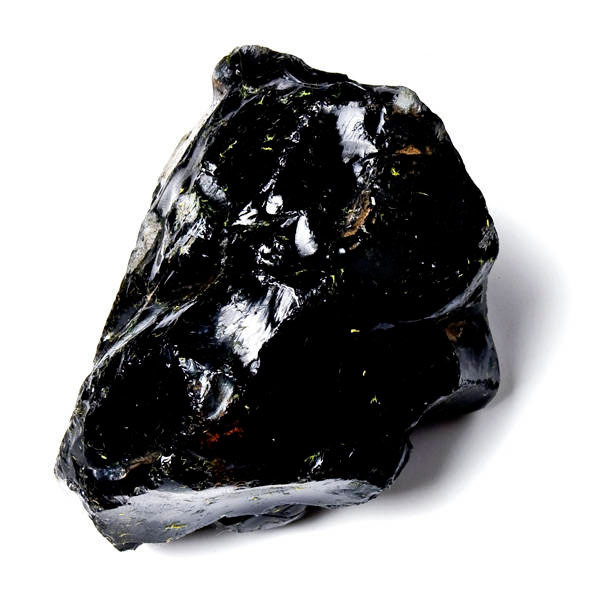
La obsidiana no es estrictamente un mineral, sino una roca ígnea extrusiva compuesta de vidrio volcánico. Se forma cuando la lava rica en sílice se enfría de forma tan extremadamente rápida que los cristales no tienen tiempo de crecer, resultando en una textura vítrea y suave. Su característica más famosa es su fractura concoidea, que produce bordes curvos tan afilados que pueden ser más delgados que una célula humana. Aunque suele ser negra debido a la presencia de hierro y magnesio, las inclusiones de gas o microcristales pueden crear variedades espectaculares como la obsidiana "copo de nieve", "dorada", "plateada" o la "arcoíris".
| Fórmula Química | $$SiO_{2}$$ |
|---|---|
| Lustre | Vítreo |
| Raya | Blanca |
| Fractura | Concoidea (muy afilada) |
| Exfoliación | Nula |
| Dureza | 6 Mohs |
| Sistema | Amorfo (sin estructura cristalina) |
¿Sabías que...?
En la medicina moderna, se fabrican escalpelos de obsidiana que son mucho más afilados que los de acero quirúrgico, permitiendo cortes más precisos y una cicatrización más rápida. Históricamente, fue la base de la economía y la guerra en Mesoamérica; los aztecas fabricaban el Macuahuitl, una espada de madera con filos de obsidiana capaces de decapitar a un caballo. Además, los espejos de obsidiana eran utilizados por sacerdotes prehispánicos para la adivinación (asociados al dios Tezcatlipoca). En la cultura popular contemporánea, la obsidiana ganó fama mundial como el "Vidrio Dragón" (Dragon Glass) en la serie Game of Thrones.
Propiedades New-Age
La obsidiana es considerada la piedra de la "verdad sin filtros". Es un guerrero protector que forma un escudo contra la negatividad y las influencias externas dañinas. Está vinculada al chakra raíz, proporcionando un enraizamiento instantáneo y profundo. Espiritualmente, actúa como un "espejo del alma", obligando al portador a enfrentarse a sus sombras y bloqueos internos para sanarlos. La Obsidiana Copo de Nieve es más suave, aportando equilibrio entre cuerpo y mente, mientras que la Obsidiana Arcoíris se utiliza para sanar corazones rotos y cortar lazos con el pasado.