Volver al listado
Volver al listado
Prehnita
Yacimientos Principales
Australia (principal productor de calidad gema), Sudáfrica, Mali, Escocia y Estados Unidos
Descripción y Características
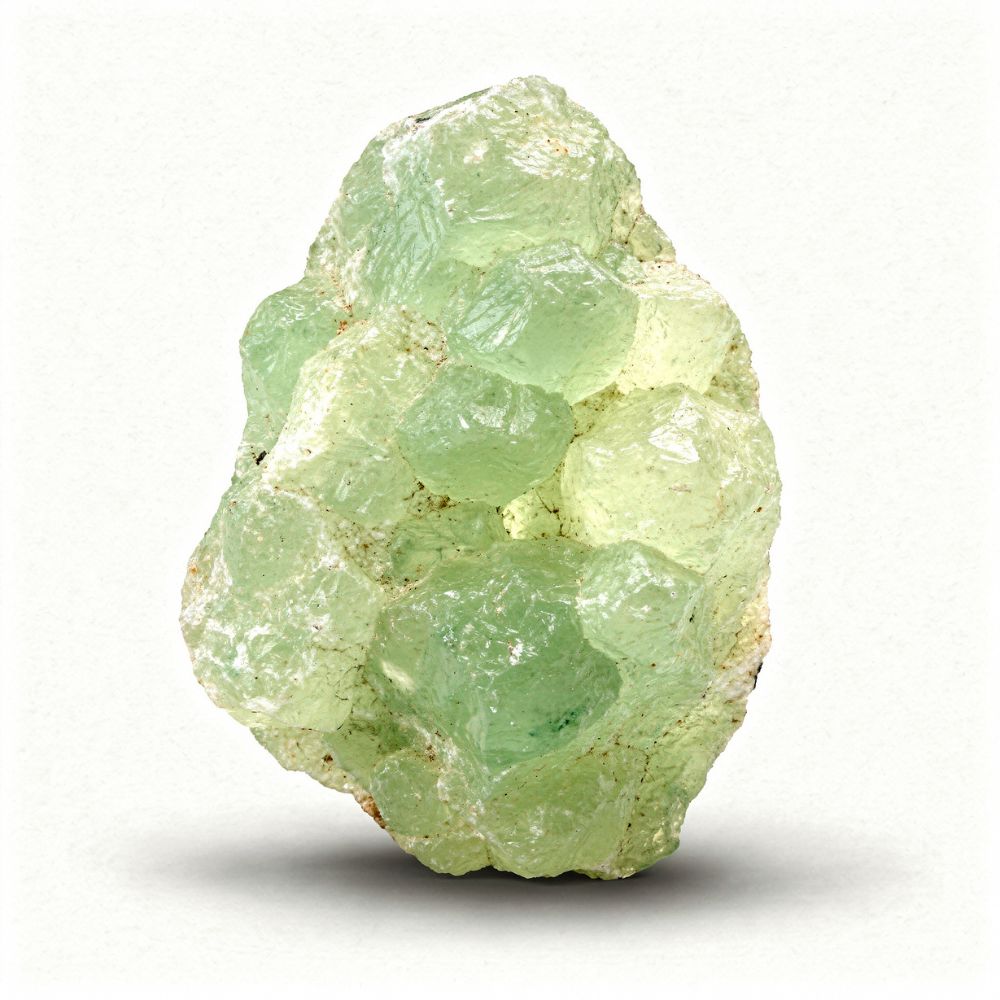
La prehnita es un silicato de calcio y aluminio que se forma típicamente en las cavidades de rocas volcánicas basálticas. Aunque puede presentarse en cristales tabulares raros, lo más común es encontrarla en hábitos botroidales (en forma de racimo de uvas) o reniformes (en forma de riñón). Su color más característico es un verde lima pálido o verde amarillento que posee una cualidad luminosa y translúcida casi sobrenatural. A menudo se encuentra asociada con la Epidota, presentando pequeñas agujas negras o verde oscuro en su interior que crean un contraste visual fascinante.
| Fórmula Química | $$Ca₂Al(AlSi₃O₁₀)(OH)₂$$ |
|---|---|
| Lustre | Viítreo o perlado |
| Raya | Blanca |
| Fractura | Irregular |
| Exfoliación | Buena en una dirección (basal) |
| Dureza | 6-6,5 Mohs |
| Sistema | Ortorrómbico |
¿Sabías que...?
Lleva el nombre del Coronel Hendrik von Prehn, quien la descubrió en el Cabo de Buena Esperanza (Sudáfrica) en 1774; esto marcó un hito en la mineralogía al ser el primer mineral nombrado por un descriptor personal. En el mercado de gemas, a veces se la llama "Jade Australiano" por su parecido visual, aunque no tienen ninguna relación mineralógica. Un dato curioso es su ligera piroelectricidad: puede desarrollar una carga eléctrica débil cuando se calienta, lo que demuestra su compleja estructura interna.
Propiedades New-Age
La prehnita es conocida como la "piedra del amor incondicional" y la sanación del sanador. Se dice que es una piedra que "sana al terapeuta", ayudando a quienes cuidan de otros a recargar su propia energía. Está vinculada al chakra del corazón y al plexo solar. Espiritualmente, facilita la visualización y la meditación profunda, permitiendo el contacto con entidades superiores y el yo interno. Es una piedra excelente para el "desapego", ayudando a limpiar el desorden (tanto físico como mental) y a dejar ir aquello que ya no es necesario para el crecimiento del alma.