
Volver al listado
Volver al listado
Quiastolita
Yacimientos Principales
España (Asturias y Galicia), Chile, Rusia, Australia y Francia
Descripción y Características
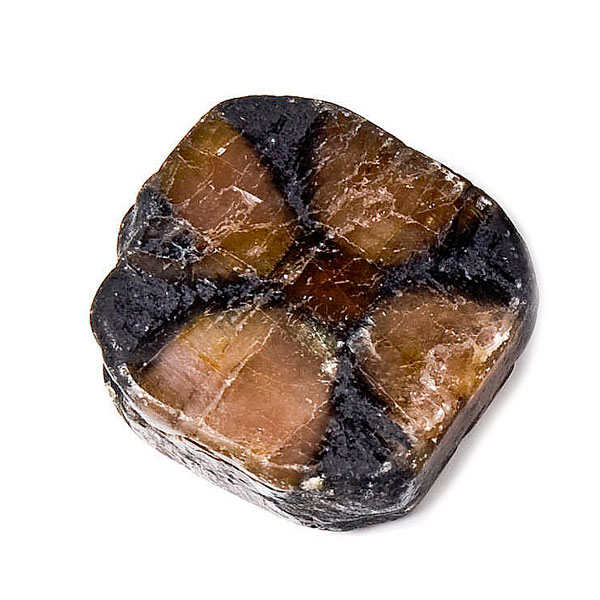
La quiastolita es una variedad de la andalucita que contiene inclusiones de carbono o grafito distribuidas de forma simétrica. Durante el crecimiento del cristal, estas partículas de carbón son empujadas hacia los márgenes por la estructura de la andalucita, formando una sección transversal en forma de cruz negra perfecta. Se forma en rocas metamórficas (esquistos) sometidas a un calor intenso. Al cortarse y pulirse en cabujón, la cruz se hace totalmente visible, lo que la convierte en una piedra única en la naturaleza que no requiere intervención humana para mostrar su símbolo sagrado.
| Fórmula Química | $$A_{l2}SiO_5$$ |
|---|---|
| Lustre | Vítreo a mate |
| Raya | Blanca |
| Fractura | Irregular a subconcoidea |
| Exfoliación | Buena en dos direcciones |
| Dureza | 6,5-7,5 Mohs |
| Sistema | Ortorrómbico |
¿Sabías que...?
Su nombre proviene del griego chiastos, que significa "marcado con una cruz" (como la letra griega Chi). En España es extremadamente famosa, especialmente en Galicia y Asturias, donde se conoce como la "Piedra de Santiago" o "Lapis Cruciat". Los peregrinos del Camino de Santiago la han utilizado durante siglos como amuleto y prueba de su viaje. Un dato geológico fascinante es que, si se calienta intensamente, la quiastolita puede transformarse en mullita, un mineral muy raro, manteniendo la forma de sus cristales originales.
Propiedades New-Age
La quiastolita es conocida como la "piedra de la protección" y la señal de identidad. Históricamente, se ha utilizado para desviar el mal de ojo y las maldiciones. Es una piedra de enraizamiento muy poderosa que ayuda a transformar la disensión en armonía. Espiritualmente, facilita el viaje astral y ayuda a entender la inmortalidad del alma, siendo una guía excelente durante los procesos de cambio o transición profunda. Ayuda a disipar los miedos y a fortalecer la resolución, permitiendo que la persona se mantenga centrada y protegida en situaciones de caos o conflicto.