Volver al listado
Volver al listado
Septarea
Yacimientos Principales
Madagascar (los ejemplares más estéticos), Estados Unidos (Utah), Marruecos y Nueva Zelanda
Descripción y Características
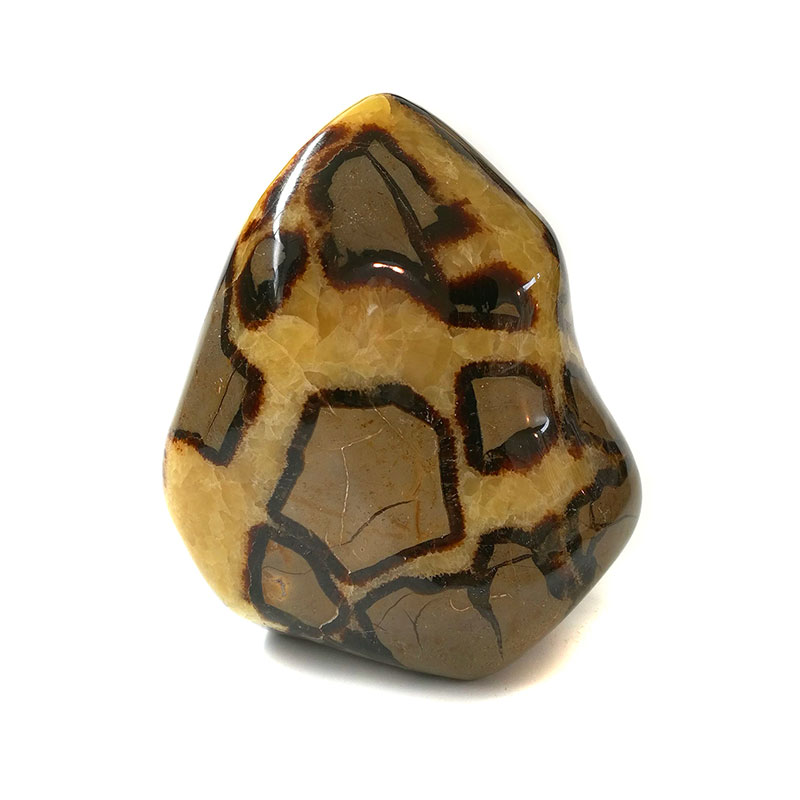
La septaria es una concreción sedimentaria que se formó durante el periodo Cretácico (hace unos 50 a 70 millones de años). Se originó a partir de bolas de lodo ricas en bentonita que se agrietaron al secarse bajo el lecho marino. Con el tiempo, estas grietas se rellenaron con filtraciones de calcita (que forma el centro amarillo), aragonito (las líneas marrones que delimitan las grietas) y, a veces, caliza o barita (la capa exterior gris). Su nombre proviene del latín septum (partición), haciendo referencia a las grietas o divisiones que separan los diferentes minerales en su interior.
| Fórmula Química | $$CaCO_3$$ |
|---|---|
| Lustre | Vítreo a mate |
| Raya | Blanca |
| Fractura | Irregular |
| Exfoliación | No aplicable (es una roca compuesta) |
| Dureza | 3.5-4 Mohs |
| Sistema | Trigonal / Ortorrómbico (según el mineral dominante) |
¿Sabías que...?
Debido a su apariencia escamosa y sus patrones internos, se la conoce popularmente como "Piedra de Huevo de Dragón", especialmente cuando se pulen de forma ovoide. Es común que algunas septarias sean fluorescentes, brillando en tonos amarillos o verdosos bajo luz ultravioleta debido a la calcita. Al ser una mezcla de carbonatos, es muy sensible a los ácidos y no debe sumergirse en agua durante periodos prolongados, ya que los diferentes minerales que la componen podrían reaccionar de forma distinta y dañar la pieza.
Propiedades New-Age
La septaria es conocida como la "piedra del orador" y el enraizamiento. Se dice que ayuda a quien habla en público a ganar confianza y a captar la atención de la audiencia. Está vinculada al chakra raíz y al plexo solar. Espiritualmente, es una piedra de gran protección que ayuda a establecer límites saludables y a mantener la privacidad cuando es necesario. Mentalmente, ayuda a concretar ideas y a ser más paciente, siendo ideal para personas que inician proyectos a largo plazo. Se considera una piedra de "cohesión" que une las energías del grupo hacia un objetivo común.