Volver al listado
Volver al listado
Topacio
Yacimientos Principales
Brasil (principal productor mundial), Rusia, Pakistán, Sri Lanka y Estados Unidos (Utah)
Descripción y Características
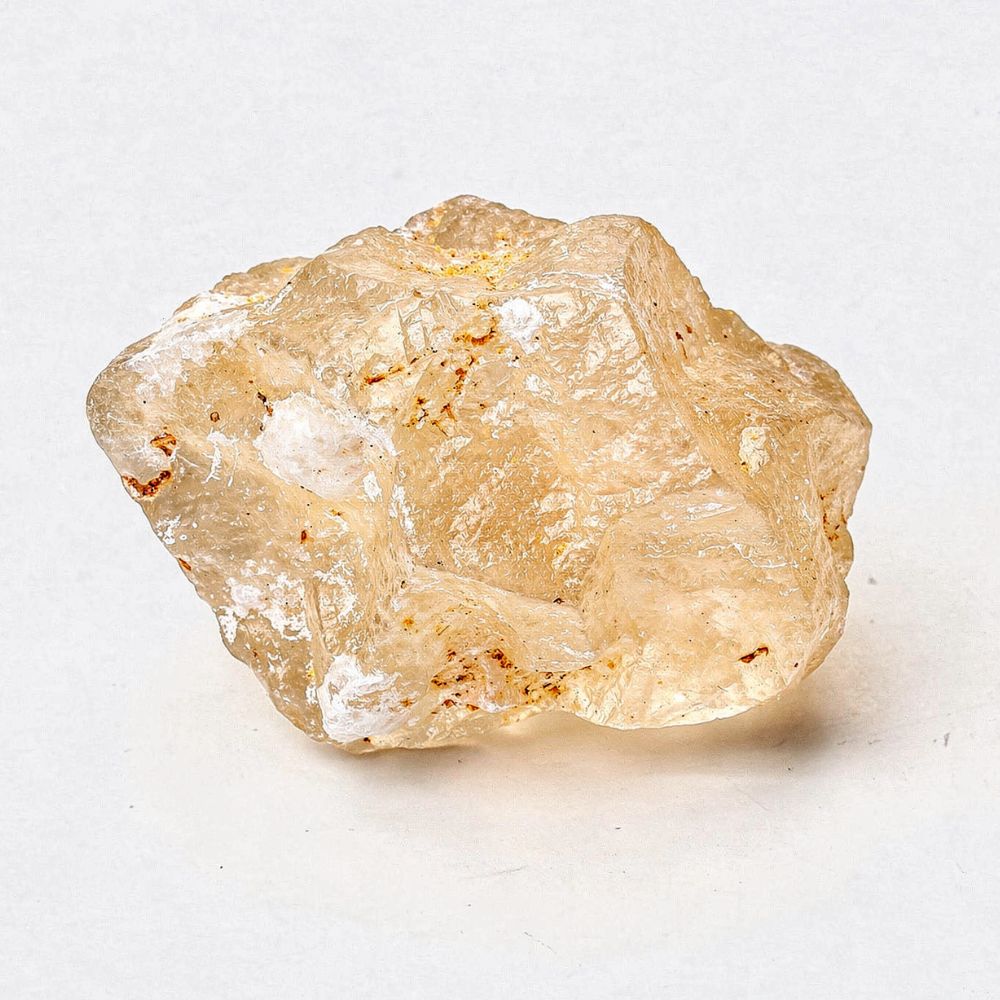
El topacio es un silicato de aluminio y flúor que se forma típicamente en rocas ígneas como granitos y riolitas, así como en cavidades de pegmatitas. Es una gema alocromática, lo que significa que en su estado puro es completamente incolora; los colores que vemos (azul, amarillo, rosa) se deben a defectos en su estructura cristalina o a la presencia de elementos traza. Es un mineral muy duro y pesado que cristaliza en prismas elegantes. El Topacio Imperial, de color naranja dorado a rosado, es la variedad más rara y valiosa del mundo.
| Fórmula Química | $$A_{l2}(SiO_4)(F,OH)_2$$ |
|---|---|
| Lustre | Vítreo |
| Raya | Blanca |
| Fractura | Concoidea a irregular |
| Exfoliación | Perfecta en una dirección (basal) |
| Dureza | 8 Mohs |
| Sistema | Ortorrómbico |
¿Sabías que...?
Debido a su exfoliación perfecta, el topacio es una gema "traicionera": aunque es muy dura (8 en la escala de Mohs), un golpe seco en el ángulo correcto puede partir la piedra limpiamente en dos. El famoso "Diamante de Braganza", una joya de 1.680 quilates incrustada en la corona portuguesa, se creyó durante siglos que era un diamante, pero en realidad es un topacio incoloro de una claridad excepcional. Casi todo el topacio azul que vemos hoy en día en las joyerías ha sido tratado con radiación y calor para alcanzar esos tonos intensos, ya que el azul natural es muy pálido y raro.
Propiedades New-Age
El topacio es conocido como la "piedra de la intención" y la abundancia. Se dice que ayuda a dirigir la energía hacia donde más se necesita, ayudando a manifestar deseos y metas. Está vinculado al chakra del plexo solar (topacios amarillos) y al de la garganta (topacios azules). Espiritualmente, aporta alegría, generosidad y salud. Es una piedra excelente para la visualización y la meditación, ya que ayuda a limpiar el aura y a sintonizar con los planos superiores de conciencia. Se cree que ayuda a encontrar el camino propio y a confiar en las decisiones tomadas.